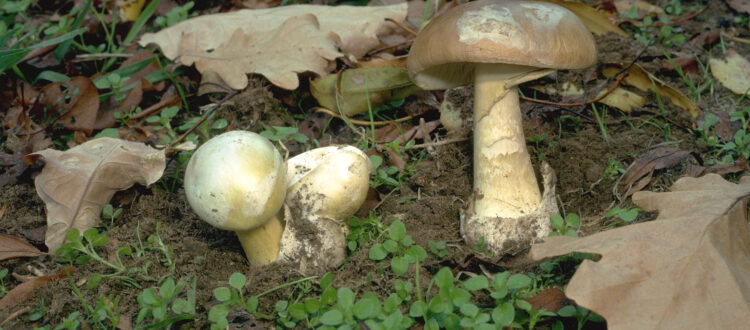
With wild mushrooms springing up around Australia this Autumn after more temperate weather and heavy rain, the Food Safety Information Council is issuing its annual warning to people not to pick or eat wild mushrooms because of the poisoning risk, particularly from the deadly deathcap mushroom.
Lydia Buchtmann, Food Safety Information Council CEO, said that foraging for wild food is becoming a popular activity, especially through promotion in social media groups with several thousand members, but gathering wild mushrooms can be life-threatening.
‘The poison in one Deathcap Mushroom, if eaten, is enough to kill a healthy adult. There have been deaths in Australia and overseas from consuming deathcap mushrooms,’ Ms Buchtmann said.
Follow these tips to keep you and your family safe:
Where might you find Deathcap mushrooms? They can appear at any time of year but are more common a week or two after good rains and in temperate weather. They have been found in the Canberra region, in and around Melbourne, in NSW and Tasmania and in Adelaide. They are not native to Australia and are often found growing near oak or beech trees in warm wet weather. The similar native marbled deathcap mushroom has been found in WA; although they may not be as toxic, they are also potentially fatal if eaten. While no cases have been reported in other States it is possible that they also grow there.
Can you easily identify Deathcap mushrooms? No. Deathcap mushrooms are difficult to distinguish from some other wild mushrooms, so we recommend you play it safe and only eat mushrooms that you have purchased from a supermarket, greengrocer or other reputable source. People born overseas, especially in Asian or European countries, should be aware that these deadly mushrooms can look like edible mushrooms they may have gathered in their home countries. Don’t rely on social media groups to ID your mushrooms from photographs correctly, even highly qualified experts have difficulty identifying them correctly.
Can you remove the toxin by cooking? No. The toxin in deathcap mushrooms is not destroyed by peeling, cooking or drying. Symptoms of poisoning include vomiting, diarrhoea and stomach cramps and usually appear 10 to 16 hours after eating. These symptoms may ease for 2 to 3 days before a terminal phase of 3 to 4 days begins. Without early, effective medical intervention people may go into a coma and die after 2 or 3 weeks of liver and kidney failure.
Are other wild mushrooms poisonous? While rare, most of the deaths from mushroom poisoning in Australia result from deathcap mushrooms. However, there are other wild mushrooms in Australia that have caused fatalities or can make you seriously ill with abdominal pain, vomiting and diarrhoea. These include species that contain toxins similar to those in the Deathcap, such as the Deadly Dapperling (Lepiota brunneoincarnata), which has caused at least four human and five dog poisonings in South Australia in the last eight years, several Cortinarius (webcap) and Galerina species, the less deadly Ghost Mushroom (commonly mistaken for oyster mushrooms), and the Yellow Stainer, which resembles a field mushroom, and is the most commonly ingested poisonous mushroom in Victoria, New South Wales and South Australia.
Keep your children and pets safe too. Many accidental exposures to poisonous mushrooms are in children under 5 years, remember that small children have a natural inclination to put things in their mouths so keep an eye on them when outdoors. Parents, school and childcare workers should regularly check outdoor areas and gardens for mushrooms and remove them to reduce the risk of accidental poisoning. This will also protect your pets.
What to do if you suspect you or your child may have eaten a deathcap mushroom. Don’t wait for symptoms to occur but go to a hospital emergency department taking the mushroom (or a photo of the mushroom) with you if you can. You can also contact the Poisons Information Centre from anywhere in Australia on 13 11 26 (24 hours a day 7 days a week).
‘Finally, don’t take the risk of foraging for other wild food as mushrooms are not the only hazard. In December 2022 more than 190 Australians became ill after eating commercially grown spinach that had been accidentally contaminated with a weed known as thornapple (Datura stramonium) a type of nightshade also known as jimson weed. This weed can easily resemble an edible green. Gathering wild food is also a risk for foodborne illness from contamination with animal faeces and parasites,’ Ms Buchtmann concluded.
Media contacts:
Lydia Buchtmann, Food Safety Information Council, 0407 626 688, or info@foodsafety.asn.au
Further information:
If you have concerns about possible wild mushroom poisoning contact the Poisons Information Centre on 13 11 26
Further information:
If you have concerns about possible wild mushroom poisoning contact the Poisons Information Centre on 13 11 26
ACT Health: If you think you see any possible Deathcap mushrooms growing in Canberra do not touch but report them contact Access Canberra on 13 22 81 see more information
NSW Health see more information
Queensland see more information
Better Health Channel (Victorian Government) see more information
Australian National Botanic Gardens see more information
WA Health: see more information
Tasmania more information
Pets – Australian Animals Poisons Centre (AAPC) 1300 TOX PET (AU)